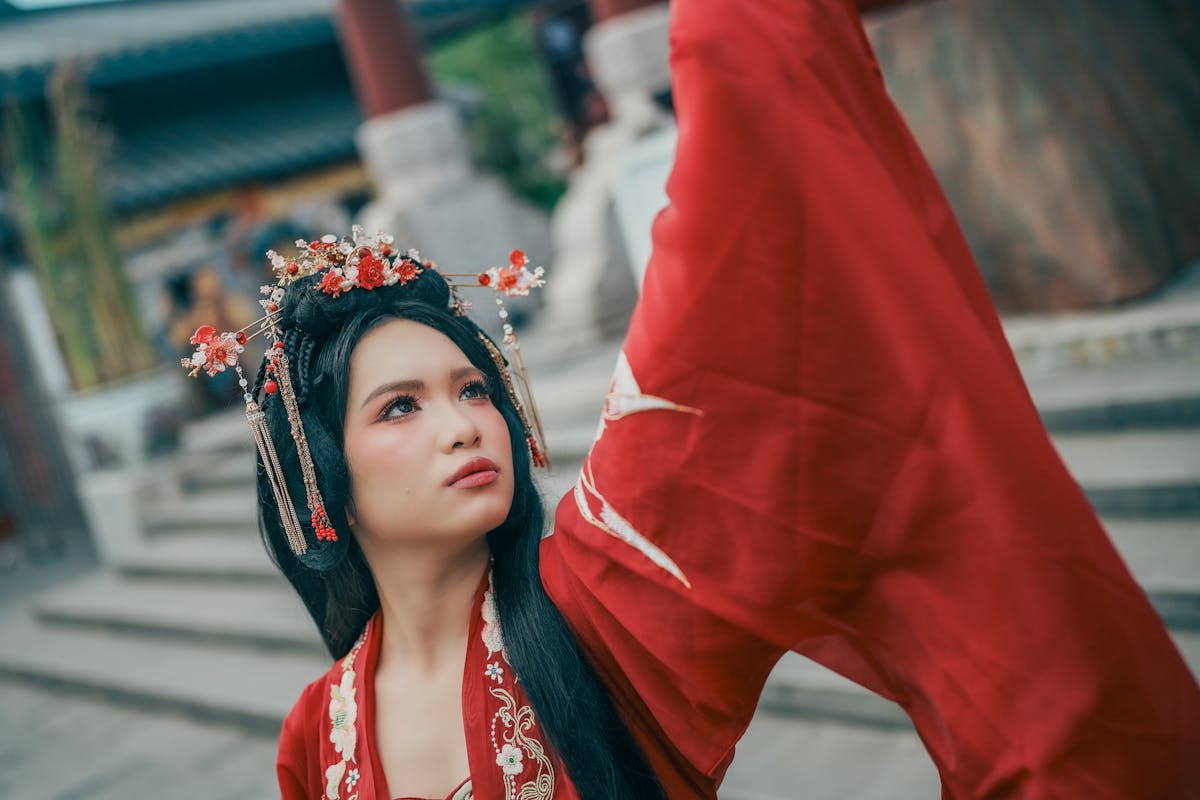
In 2015, the average costume budget for a Chinese xianxia (immortal hero) drama was approximately 3 million RMB. By 2026, that figure has exceeded 25 million RMB for top-tier productions. This tenfold increase reflects not just inflation but a fundamental transformation in how the genre's visual identity is conceived, constructed, and consumed. Xianxia costume design has evolved from an afterthought to the primary visual differentiator between competing productions in the most crowded genre in Chinese television.
2015-2017: The Foundation Era
The modern xianxia costume era begins with Journey of Flower (2015) and Eternal Love (Three Lives Three Worlds, Ten Miles of Peach Blossoms) (2017). Before these productions, xianxia costumes were largely indistinct — flowing robes in limited color palettes, minimal differentiation between celestial realms, and a reliance on post-production visual effects to compensate for basic physical wardrobes.
Eternal Love changed the calculus. Costume designer Huang Xue created a color-coding system that assigned specific palettes to each celestial realm — white and blue for the Fox Clan, purple and gold for the Heavenly Emperor, deep red and black for the Demon Realm. This system, simple in concept, gave audiences an immediate visual grammar for understanding the show's complex mythology. Yang Mi's white robes as Bai Qian became the defining image of the genre, spawning a consumer hanfu market that did not meaningfully exist before the show aired.
The technical execution, however, remained basic. Fabrics were predominantly synthetic chiffon and polyester satin. Embroidery was machine-produced. Armor elements were lightweight foam and plastic. Costumes were designed to be seen at medium to wide shot distances and did not hold up under close inspection.
2018-2019: The Craft Revolution
Two productions transformed xianxia costume expectations: Ashes of Love (2018) and The Untamed (2019). See full drama reviews and episode guides for both series on CDramaPedia.
Ashes of Love's wardrobe department, led by designer Zhang Rui, introduced genuine handcraft to xianxia productions. The celestial costumes featured real silk organza, hand-dyed using traditional plant-based pigments. The embroidery for lead characters was completed by Suzhou artisans using traditional su xiu techniques — a decision that increased the costume budget by approximately 40% but created garments that could withstand the high-definition cameras being adopted by Chinese production studios.
The Untamed took a different approach: narrative specificity. Rather than defaulting to generic "celestial" aesthetics, costume designer Liu Jie created distinct visual identities for each cultivation sect. The Gusu Lan Sect wore structured, layered white with cloud motifs and rigid forehead ribbons. The Yunmeng Jiang Sect wore looser, warmer purples and blues. The Wen Sect wore aggressive reds. Each sect's costumes incorporated unique construction details — collar styles, sleeve attachments, belt configurations — that fans catalogued exhaustively on social media.
2020-2022: The Technology Integration
The middle period of xianxia costume evolution was defined by the integration of digital technology with physical garment construction.
Love and Redemption (2020) was among the first productions to use CLO 3D software for costume prototyping, allowing designers to test silhouettes and fabric drape digitally before committing to physical construction. This reduced waste and allowed for more experimental designs — wider sleeves, more complex layering, unconventional fabric combinations — that would have been too risky to prototype physically.
Who Rules the World (2022) introduced thermochromic and photochromic elements to xianxia costumes — fabrics that shifted color subtly under different lighting conditions. The technology was used sparingly (primarily for transformation scenes), but it established that xianxia costumes could incorporate functional technology alongside traditional craftsmanship.
This period also saw the standardization of separate "action" and "beauty" costume versions for lead characters. The beauty version — constructed from delicate silks with extensive embroidery — was used for dialogue scenes and close-ups. The action version — constructed from more durable fabrics with simplified embellishment — was used for wire-work and fight choreography. Lead characters in major productions now require 15-20 costume sets to accommodate this dual-version approach.
2023-2024: The Couture Era
The release of Till The End of The Moon (2023) and Love Between Fairy and Devil (2023) marked the beginning of what industry observers call the "couture era" of xianxia costume design — a period where production wardrobes began to rival the craftsmanship of haute couture fashion houses.
Till The End of The Moon's costume budget reportedly exceeded 18 million RMB — a figure that would fund several entire productions a decade earlier. Lead character costumes required three to four months of construction each. The embroidery for Luo Yunxi's demon god wardrobe incorporated metallic threads of actual silver, creating a dark shimmering effect that read as supernatural menace on camera without relying on post-production enhancement.
The fan response matched the investment. Costume analysis videos for Till The End of The Moon accumulated over 500 million views on Bilibili and Douyin. Individual costume reveals became marketing events, with studios releasing behind-the-scenes embroidery footage as promotional content — a practice that would have been unthinkable in the genre's early years.
2025-2026: The Present Moment
Current xianxia productions operate at a level of visual ambition that has created both opportunities and challenges for the industry.
On the opportunity side, the investment in costume design has elevated the genre's cultural status. Chinese fashion publications now cover xianxia costume design alongside Paris and Milan runway collections. University programs in costume design have expanded their curricula to include xianxia-specific modules. And the consumer market for xianxia-inspired fashion — from direct costume reproductions to modern adaptations — generates an estimated 8 billion RMB annually.
On the challenge side, the escalating costume budgets have created an arms race that disadvantages smaller productions. The audience expectation for visual splendor, established by high-budget productions, applies equally to dramas with a fraction of the resources. This has led to creative solutions — some productions now partner with fashion brands or hanfu companies to co-produce costumes, sharing costs in exchange for commercial tie-ins.
What Comes Next
The trajectory of xianxia costume design points toward several developments. Sustainable production methods are becoming a priority, with studios exploring recycled fabrics and modular costume systems that allow elements to be recombined across productions. Virtual costume fitting and AI-assisted pattern generation are reducing pre-production timelines. And the growing international audience for xianxia dramas is creating demand for costume exhibitions and touring shows that extend the commercial life of production wardrobes beyond their screen appearances.
The xianxia costume of 2026 is unrecognizable compared to its 2015 ancestor. What began as a functional necessity — dressing actors in fantasy robes — has become an art form that synthesizes centuries of Chinese textile tradition with cutting-edge technology and cinematic design thinking. The next decade will determine whether this trajectory is sustainable, or whether the genre's visual ambitions will eventually outpace the industry's capacity to fund them.
Interested in collecting xianxia-inspired costumes, accessories, and artisan embroidery pieces? Shop authentic merchandise at Pandafame. For detailed collector guides on drama memorabilia, visit Fandom Collection.
Last updated: 2026-03-28. CDrama Style's costume analysis tracks the evolving visual language of Chinese television.
Tags