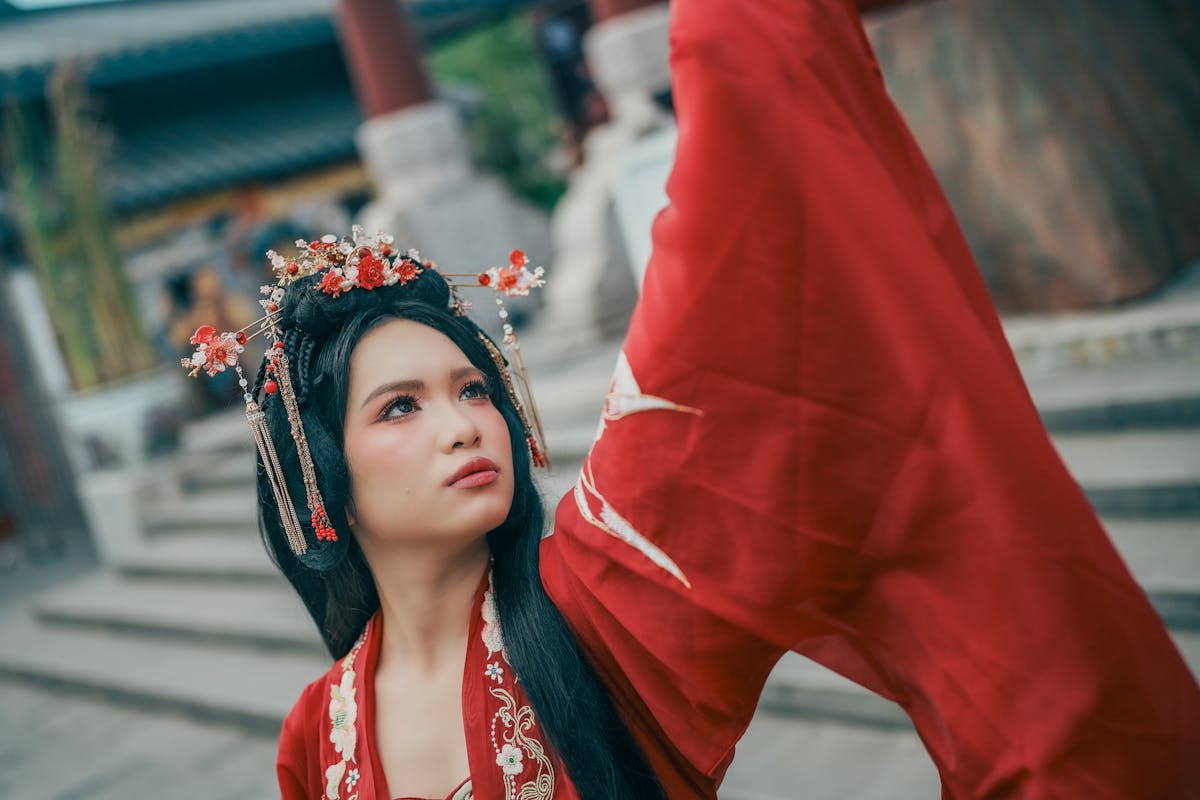
When Bai Lu descended a staircase in a five-layer silk organza gown during the finale of Till The End of The Moon, viewers across 190 countries paused to screenshot. That single costume required 800 hours of hand-embroidery, three fittings, and a team of twelve artisans working in a Hengdian Studios workshop. It was designed to be seen for approximately forty-five seconds of screen time.
This is the reality of Chinese drama costume design in 2026 — a discipline that operates at the intersection of haute couture craftsmanship, historical scholarship, and cinematic storytelling. The results are some of the most visually ambitious wardrobes in global television, yet the designers behind them remain largely unknown outside of industry circles.
The Scale of Modern C-Drama Wardrobe Departments
A single high-budget Chinese drama typically requires between 300 and 1,200 individual costumes. For period dramas set across multiple dynasties, that number can exceed 2,000. Contrast this with a typical Western television production, where a contemporary drama might require 50-80 costumes per season, and the scale becomes clearer.
The wardrobe department for a major xianxia production like Love Between Fairy and Devil employed over 40 full-time seamstresses, dyers, and embroiderers for an eight-month production cycle. Fabrics were sourced from Suzhou silk mills, Hangzhou brocade workshops, and, increasingly, specialized suppliers in Jingdezhen who produce fabrics with integrated metallic threads designed specifically for camera work.
Fang Siqi, arguably the most influential costume designer in Chinese television today, described her approach in a 2025 interview with Bazaar China: "Every costume must work at three distances — the wide shot, the medium shot, and the close-up. A gown that looks magnificent across a courtyard must also reveal new details when the camera pushes in to the actor's face."
Historical Accuracy vs. Creative License
The tension between historical fidelity and visual storytelling defines much of C-drama costume design. Purists argue that dramas set in specific dynasties should adhere to documented clothing conventions — the cross-collar left-over-right construction of Han Dynasty hanfu, the high-waisted ruqun silhouettes of the Tang, the restrained elegance of Song Dynasty aesthetics.
In practice, most productions blend historical reference with creative interpretation. Zhang Shuping, the veteran Hong Kong designer who has dressed everyone from Zhang Ziyi to Tony Leung, approaches historical drama as "emotional archaeology" — using period silhouettes and construction techniques as a foundation, then adapting proportions, colors, and embellishment for modern screen sensibilities.
The Tang Dynasty, for example, is consistently depicted with saturated color palettes and voluminous sleeves because these elements read powerfully on camera. Historical evidence suggests the actual color range was somewhat more muted, and sleeve dimensions varied considerably by social class and occasion. But the exaggerated version has become the visual shorthand that audiences expect.
The Sui-Tang Color Code
- Imperial yellow — reserved for emperor and empress in nearly every production, though historically its exclusive use was established later in the Tang
- Deep red and persimmon — high-ranking officials and noble consorts, signaling power and fertility
- Jade green and celadon — scholars, physicians, and spiritual figures, conveying wisdom
- White and silver — typically reserved for mourning scenes or characters of ethereal, otherworldly nature
- Black with gold accents — antagonists and morally ambiguous characters, a convention borrowed from Beijing opera
The Embroidery Economy
Chinese drama costume embroidery has created a micro-economy within the entertainment industry. Studios in Suzhou — historically the center of Chinese silk embroidery — now dedicate entire workshops to television production work. A single phoenix motif for a lead character's wedding gown can take 400-600 hours to complete, with artisans working in rotation.
The techniques employed are genuine heritage crafts: Suzhou embroidery (su xiu), Hunan embroidery (xiang xiu), Sichuan embroidery (shu xiu), and Guangdong embroidery (yue xiu) — the four great traditions of Chinese needlework. Productions compete to secure the most skilled artisans, and leading embroiderers have become celebrities within the industry, commanding fees that rival those of supporting actors.
Modern Drama: The Quiet Revolution
While period dramas dominate discussions of C-drama fashion, contemporary productions have undergone their own design revolution. Shows like Nothing But Thirty, Go Ahead, and My Huckleberry Friends pioneered a naturalistic approach to costume design that deliberately avoids the "too perfect" aesthetic that had characterized earlier modern dramas.
Stylist Liu Xiaoyan, who dressed the ensemble cast of Nothing But Thirty, explained that each character's wardrobe was built from actual retail purchases: Zara for the aspirational professional, COS for the understated intellectual, Chanel for the established socialite. The goal was believability — viewers should be able to identify, and potentially purchase, similar pieces.
This shift has transformed modern C-dramas into powerful commercial platforms. When a character appears in an identifiable piece, e-commerce searches for that item spike within hours. Taobao's "same style" (tongkuan) search feature processes millions of drama-inspired queries monthly, making costume designers inadvertent trend forecasters for the Chinese retail market.
Technology and Tradition
Digital tools have begun to reshape the design process without replacing traditional craftsmanship. Leading costume designers now use CLO 3D software to prototype silhouettes before committing to fabric, reducing waste and allowing directors to preview costumes in virtual environments that approximate final lighting conditions.
CGI enhancement of costumes is also increasingly common, particularly for fantasy and xianxia productions. Flowing fabric in wind effects, luminous embroidery that appears to glow, and color-shifting fabrics that change hue with camera angle are all achieved through post-production augmentation of physical costumes. The result is a hybrid aesthetic that could not exist in either purely physical or purely digital form.
The Global Conversation
As Chinese dramas reach global audiences through Netflix, Viki, and WeTV, their costume design has entered a broader cultural conversation. The Metropolitan Museum of Art's 2025 exhibition "Threads of Empire: Chinese Television Costume Design" marked a institutional recognition of the field's artistic merit, featuring original costumes from eight major productions alongside historical garments from the museum's Asian Art collection.
For the designers working in Hengdian's studios and Suzhou's embroidery workshops, this global attention represents both validation and pressure. The next generation of C-drama costume design will need to honor the traditions that make it distinctive while continuing to innovate for audiences who increasingly understand the visual grammar of Chinese period fashion.
The forty-five seconds of screen time for that Bai Lu gown? It represents thousands of hours of accumulated knowledge, hundreds of hours of labor, and a design philosophy that treats every frame as an opportunity to tell a story through fabric, thread, and form.
Further Reading
For comprehensive reviews of dramas mentioned in this article, including Till The End of The Moon and Love Between Fairy and Devil, see full reviews on CDramaPedia. If you are interested in collecting replica costumes, embroidered accessories, or artisan hanfu inspired by these productions, browse authentic merchandise at Pandafame and find collector guides at Fandom Collection.
Last updated: 2026-03-28. CDrama Style's costume analysis series covers the craft behind Chinese television's most iconic wardrobes.
Tags